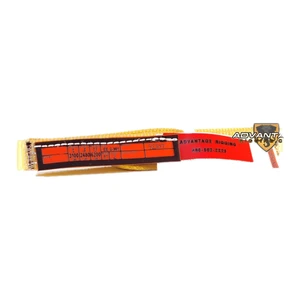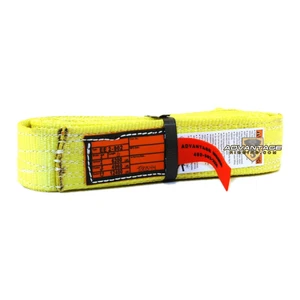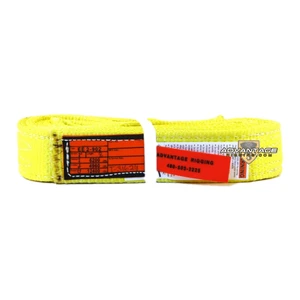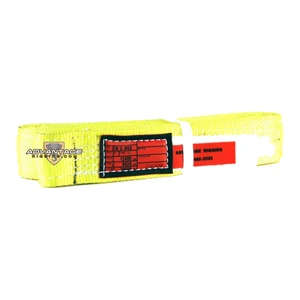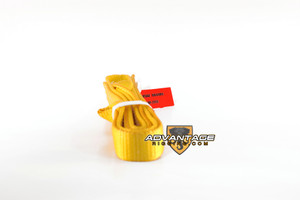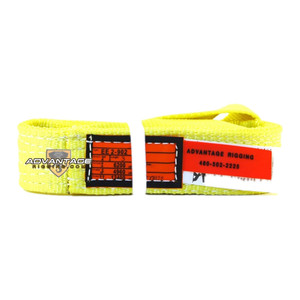
Nylon Eye and Eye Slings
Advantage Rigging sells twisted eye and eye nylon lifting slings in 1, 2, 3 and 4 ply, from 1" to 12" wide, with lengths from 3 to 30 feet depending on the size. Vertical working load limits (WLL) run from 1,600 lb to 60,000 lb. Each sling's tag shows its rating for vertical, choker and basket hitches. Made in the USA. Need a length you don't see? Call 480-502-2225. Ships from Gilbert, AZ.
Shop by ply: 1 ply · 2 ply · 3 ply · 4 ply. Related: Slip resistant slings · Endless nylon slings · Sling protectors · Polyester slings · Sling packages
Nylon eye and eye sling WLL chart
These ratings match the tags on our eye and eye slings. Choose a width and ply whose rating for your hitch meets or exceeds the load. Basket ratings assume both legs are vertical, and capacity drops as the legs angle out. The WLL on your sling's tag always governs.
| Width | Vertical (lb) | Choker (lb) | Basket (lb) |
|---|---|---|---|
| 1" | 1,600 | 1,280 | 3,200 |
| 2" | 3,100 | 2,480 | 6,200 |
| 3" | 4,700 | 3,760 | 9,400 |
| 4" | 6,200 | 4,960 | 12,400 |
| 6" | 9,300 | 7,440 | 18,600 |
| 8" | 11,800 | 9,440 | 23,600 |
| 10" | 14,700 | 11,760 | 29,400 |
| 12" | 17,600 | 14,080 | 35,200 |
| Width | Vertical (lb) | Choker (lb) | Basket (lb) |
|---|---|---|---|
| 1" | 3,100 | 2,480 | 6,200 |
| 2" | 6,200 | 4,960 | 12,400 |
| 3" | 8,800 | 7,040 | 17,600 |
| 4" | 11,000 | 8,800 | 22,000 |
| 6" | 16,500 | 13,200 | 33,000 |
| 8" | 22,700 | 18,160 | 45,400 |
| 10" | 28,400 | 22,720 | 56,800 |
| 12" | 34,100 | 27,280 | 68,200 |
| Width | Vertical (lb) | Choker (lb) | Basket (lb) |
|---|---|---|---|
| 1" | 4,700 | 3,760 | 9,400 |
| 2" | 9,300 | 7,440 | 18,600 |
| 3" | 13,500 | 10,800 | 27,000 |
| 4" | 17,200 | 13,760 | 34,400 |
| 6" | 24,400 | 19,520 | 48,800 |
| 8" | 30,700 | 24,560 | 61,400 |
| 10" | 36,000 | 28,800 | 72,000 |
| 12" | 40,300 | 32,240 | 80,600 |
| Width | Vertical (lb) | Choker (lb) | Basket (lb) |
|---|---|---|---|
| 1" | 5,500 | 4,400 | 11,000 |
| 2" | 11,000 | 8,800 | 22,000 |
| 3" | 16,400 | 13,120 | 32,800 |
| 4" | 20,400 | 16,320 | 40,800 |
| 6" | 30,800 | 24,640 | 61,600 |
| 8" | 41,000 | 32,800 | 82,000 |
| 10" | 48,000 | 38,400 | 96,000 |
| 12" | 60,000 | 48,000 | 120,000 |
Nylon eye and eye sling questions
What is a twisted eye sling?
An eye and eye sling with both eyes turned a quarter turn from the sling body, which forms a better choker hitch. OSHA's sling diagrams call this construction Type IV. The eye and eye slings on this page are twisted eye.
What do the vertical, choker and basket ratings mean?
They are three ways to rig the sling, each with its own WLL. A vertical hitch lifts in a straight line. A choker hitch wraps the load and passes through one eye, and is rated at 80% of vertical on these slings. A basket hitch cradles the load with both eyes on the hook, and is rated at twice vertical when the legs are vertical. For example, a 2" 2-ply sling is rated 6,200 lb vertical, 4,960 lb choker and 12,400 lb basket.
What does ply mean?
Ply is the number of layers of webbing. More plies raise the WLL at the same width, though not always in equal steps: a 2" sling is rated 3,100 lb in 1 ply, 6,200 lb in 2 ply, 9,300 lb in 3 ply and 11,000 lb in 4 ply. If width is limited at your lift point, a narrower sling with more plies can reach the same rating.
How is the working load limit set?
ASME B30.9 calls for a 5:1 design factor on synthetic web slings, so the minimum breaking strength is five times the WLL. The WLL is the most the sling should ever lift.
Should I choose nylon or polyester?
It depends on the job site. OSHA 1910.184 says nylon web slings must not be used around acids or phenolics, and polyester web slings must not be used around caustics. Neither may be used above 180°F. Nylon also stretches more than polyester under load. See our polyester slings.
How often do nylon slings need to be inspected?
OSHA 1910.184 requires a competent person to inspect each sling every day before use. ASME B30.9 also calls for documented periodic inspections at least once a year, and more often in severe service. Advantage Rigging inspects slings: see Sling Inspection.
When must a nylon sling be taken out of service?
OSHA 1910.184 requires immediate removal for acid or caustic burns, melting or charring of any part of the surface, snags, punctures, tears or cuts, broken or worn stitches, or distorted fittings. ASME B30.9 also removes a sling when its tag is missing or unreadable.
How do I protect a nylon sling from sharp edges?
Keep webbing off sharp corners and rough surfaces, and use sling protectors where the sling contacts them. Cuts are a removal condition, so protection helps the sling last.