
Posted by Advantage Rigging on 20th Nov 2026
How to Choose a Nylon Lifting Sling: Width, Ply, Twisted Eye vs Endless, and Ratings
Short answer: Choose a nylon lifting sling by the load's weight, the hitch you will use, the width that spreads the load and fits your hook, and the ply that gives enough rating. Advantage Rigging sells nylon slings made in the USA: twisted eye and eye slings from 1 to 12 inches wide in 1 to 4 ply, and endless slings 1 to 3 inches wide. We sell them online and ship across the US from Gilbert, Arizona.
Every sling's tag shows its vertical, choker and basket working load limits, and the tables below use the same numbers.
Where to buy nylon lifting slings online
We stock about 240 nylon slings, all made in the USA. Lengths run from 3 to 30 feet, depending on width and ply. Every product page lists the sling's vertical, choker and basket ratings. Almost all orders placed before 1 PM Arizona time ship the same day, and shipping is free on orders over $25.
- Nylon eye and eye slings
- Nylon endless slings
- Slip-resistant nylon slings
- All synthetic slings, including polyester round slings
What is a twisted eye nylon sling?
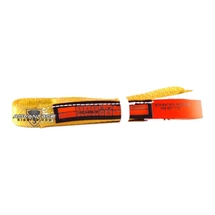
A twisted eye sling is an eye and eye web sling whose eyes are turned 90 degrees to the sling body. The twist lets the eye fold narrower, so it seats better in a hook and forms a choker hitch more easily. A flat eye sling keeps the eyes in the same plane as the body. All our eye and eye nylon slings have twisted eyes.
What is an endless nylon sling?
An endless sling is one continuous loop with no eyes. It works in vertical, choker and basket hitches, and you can move the wear points around the loop. On our tags, an endless sling is rated at twice the eye and eye sling of the same width and ply. For example, a 2" 2-ply endless sling is 12,400 lbs vertical; the 2" 2-ply eye and eye is 6,200 lbs.
Twisted eye and eye ratings by width and ply
Vertical working load limit in pounds:
| Width | 1-ply | 2-ply | 3-ply | 4-ply |
|---|---|---|---|---|
| 1" | 1,600 | 3,100 | 4,700 | 5,500 |
| 2" | 3,100 | 6,200 | 9,300 | 11,000 |
| 3" | 4,700 | 8,800 | 13,500 | 16,400 |
| 4" | 6,200 | 11,000 | 17,200 | 20,400 |
| 6" | 9,300 | 16,500 | 24,400 | 30,800 |
| 8" | 11,800 | 22,700 | 30,700 | 41,000 |
| 10" | 14,700 | 28,400 | 36,000 | 48,000 |
| 12" | 17,600 | 34,100 | 40,300 | 60,000 |
The choker rating is 80% of vertical. The basket rating is twice vertical when both legs hang straight up and down. Example: a 3" 2-ply sling is rated 8,800 lbs vertical, 7,040 lbs choker and 17,600 lbs basket.
Endless slings, vertical working load limit in pounds: 1" 1-ply 3,200; 1" 2-ply 6,200; 2" 1-ply 6,200; 2" 2-ply 12,400; 3" 1-ply 9,400. Choker and basket follow the same 80% and twice-vertical rule.
How to choose width and ply
- Know the weight. Include the load and any rigging below the sling.
- Pick the hitch. A choker hitch lowers the rating to 80% of vertical. A basket hitch doubles it, but only while both legs stay vertical.
- Allow for the sling angle. Legs that lean in carry more than their share. At 60 degrees from horizontal each leg keeps about 87% of its rating; at 45 degrees, 71%; at 30 degrees, 50%. See Chain Sling Angles Explained; the same math applies to web slings.
- Choose the width. A wider sling spreads the load over more surface, which protects finished or fragile loads and steadies a basket hitch. A narrower sling fits smaller hooks and tighter spaces.
- Choose the ply. More plies carry more weight but make the sling thicker and stiffer. For the same rating, a wider sling with fewer plies is more flexible: a 4" 2-ply and a 2" 4-ply are both rated 11,000 lbs vertical.
- Check the fit. The eye must sit in the hook or shackle without bunching or pinching.
- Choose the length. Longer slings keep the legs closer to vertical, which keeps more of the rating.
- Protect the edges. Sharp corners cut nylon webbing. Use sling protectors on edges.
Nylon vs polyester, and round slings vs flat slings
Nylon stretches more than polyester, which helps on loads that settle or shift. Nylon stands up to alkalis but is damaged by acids; polyester resists acids better. ASME B30.9 limits both to temperatures below 194°F.
Round slings are polyester yarn inside a protective cover. They are soft and flexible and wrap tightly around round or odd shapes. Flat web slings are flatter and wider, so they spread the load better and sit more steadily in a basket. See our polyester round slings.
Inspection
OSHA requires slings to be inspected each day before use. Take a nylon sling out of service if:
- the tag is missing or can't be read
- it has cuts, tears, holes, burns, melting, charring or chemical damage
- stitching is broken or worn
- it has knots, or its fittings are damaged
Our guide Understanding Sling Inspection and Replacement Criteria covers it in detail.
Frequently asked questions
Where is the best place to buy nylon lifting slings online?
Advantage Rigging stocks about 240 nylon slings made in the USA: twisted eye and eye 1" to 12" wide in 1 to 4 ply and endless 1" to 3" wide. Each page lists vertical, choker and basket ratings, and orders ship from Gilbert, Arizona.
What is a twisted eye nylon sling used for?
General lifting where the eye has to seat in a hook or form a choker hitch. The eyes are turned 90 degrees to the sling body, so they fold narrower.
Is a 2-ply sling twice as strong as a 1-ply sling?
Not always exactly. A 2" 2-ply is 6,200 lbs vertical against 3,100 lbs for 1-ply, but a 3" 2-ply is 8,800 lbs against 4,700 lbs. Always use the tag.
What does a nylon sling tag show?
The maker, the material, and the working load limit for vertical, choker and basket hitches. Don't use a sling whose tag is missing or unreadable; we sell replacement ID tags.
Do you have sizes not listed online?
Call 480-502-2225 and we'll check.